 HOME
ABOUT
FANFIC
ESSAYS
CRAFTS
PHOTOS
MUSIC
RECIPES
CONTACT
HOME
ABOUT
FANFIC
ESSAYS
CRAFTS
PHOTOS
MUSIC
RECIPES
CONTACT
Abjection and Desire in the Smith/Neo Relationship
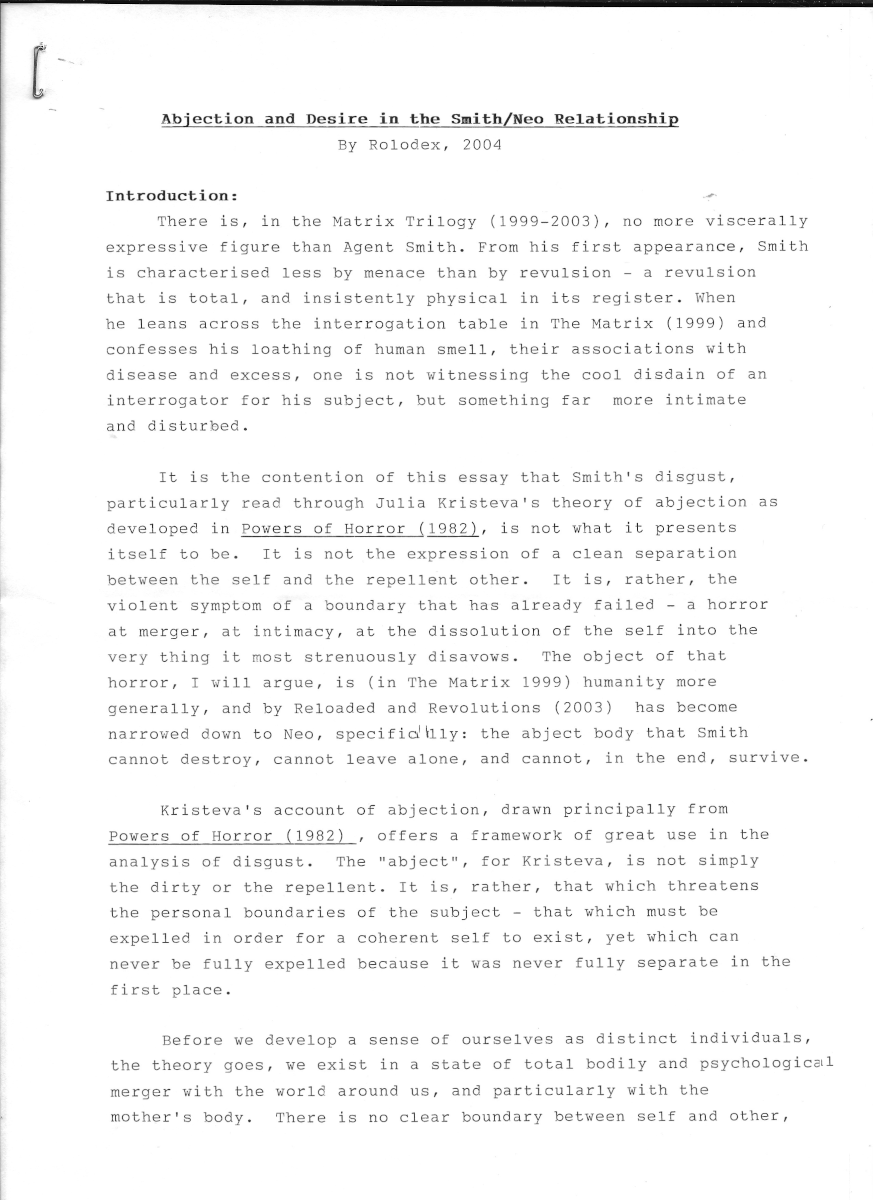
Introduction
There is, in the Matrix trilogy (1999-2003), no more viscerally expressive figure than Agent Smith. From his first appearance, Smith is characterised less by menace than by revulsion - a revulsion that is total and insistently physical in its register. When he leans across the interrogation table in The Matrix (1999) and confesses his loathing of human smell, their associations with disease and decay, one is not witnessing the cool disdain of an interrogator for his subject; but something far more intimate and disturbed.
It is the contention of this essay that Smith's disgust, particularly read through Julia Kristeva's theory of abjection as developed in Powers of Horror (1982), is not what it presents itself as being. It is not the expression of a clean separation between the self and the repellent other. It is, rather, the violent symptom of a boundary that has already failed - a horror at merger, at intimacy, at the dissolution of the self into the very thing it most strenuously disavows. The object of that horror, I shall argue, is (in The Matrix (1999)) humanity more generally, and by Reloaded and Revolutions (2003) has become narrowed down to Neo, specifically: the abject body that Smith cannot destroy, cannot leave alone, and cannot, in the end, survive.
Kristeva's account of abjection, drawn principally from Powers of Horror: An Essay on Abjection (1982), offers a framework of great use in the analysis of disgust. The “abject”, for Kristeva, is not simply the dirty or the repellent. It is, rather, that which threatens the personal boundaries of the subject - that which must be expelled in order for a coherent self to exist, yet which can never be fully expelled because it was never fully separate in the first instance. Before we develop a sense of ourselves as distinct individuals, the theory goes, we exist in a state of total bodily and psychological merger with the world around us, and particularly with the mother's body. There is no clear boundary between self and other, inside and outside.
Developing a coherent sense of "I" requires expelling or distancing ourselves from that earlier state. We have to learn that we are separate, bounded, contained. But because that merged, fluid state is where we came from, it never fully goes away. It lurks, and certain things in the world - corpses, bodily fluids, decay - trigger a kind of echo of it, a reminder that the boundaries of the self are not as solid as we need them to be.
Abjection, Kristeva argues, is always also a form of fascination: one does not simply turn away from the abject; one is drawn back to it, compelled to circle it, unable to achieve the clean separation that disgust promises but never delivers. I would argue that it is abjection: a revulsion that is also compulsion, a rejection that is also return - that characterises Smith's relationship to humanity in general (particularly in The Matrix (1999), and to Neo in particular (by the events of Reloaded and Revolutions.
“I Must Get Out of Here”
The pivotal scene for any reading of Smith's disgust occurs during the interrogation of Morpheus in The Matrix. Having dismissed his fellow Agents, Smith removes his earpiece - a small but significant severing of his connection to the system - and seats himself across from his prisoner with an air of uncharacteristic intimacy. What follows is one of the most remarkable monologues in the trilogy, and certainly a favourite of many scholar-fans of Agent Smith. Smith confesses that he finds human beings repellent: he describes them as a plague, as a disease, as a cancer, a virus. He describes the Matrix as something he cannot abide, something he is desperate to escape. He speaks, in short, the language of abjection - the language of a subject overwhelmed by the proximity of the organic, the fluid, the perishable.
Smith’s speech in this part of the scene is worth some closer attention, for it is not merely thematically abject but formally so: it enacts, at the level of the sentence, the very confusion of inside and outside that Kristeva describes. Smith’s opening gambit - “It’s the smell. If there is such a thing” - is already telling. He cannot commit to the reality of the sensation even as he is overwhelmed by it. He is simultaneously saturated and uncertain; the organic has penetrated him to the point that he cannot be sure whether what he experiences is perception or contamination.
This ambiguity intensifies as he speaks. He reaches out and draws his fingers through the sweat on Morpheus’s brow - an act of deliberate, self-willed contact with the very substance of his revulsion - and then confesses: “every time I do, I fear that I have somehow been infected by it.” The word “infected” is, in this context, extraordinarily revealing. It is the language of the already-compromised body, the body that suspects the boundary has been breached and that the contaminant is already within. In Kristeva’s terms, Smith is not merely experiencing abjection in this moment; he is articulating the structure of abject horror itself: the fear that expulsion has failed, that the other is already inside, that the self is no longer clean. His act of touching Morpheus, of rubbing the sweat between his fingers, of forcing Morpheus to smell them - is also telling. Disgust, here, is not a withdrawal; it is a forced return, an insistence on proximity, a sharing of the contamination that is also, unmistakably, a kind of intimacy. The gesture is sadistic, yes, but it is also something stranger: it is the gesture of a subject who cannot stay away from what repels him, who must touch and taste and press himself against the very thing he claims to be fleeing. And then, immediately after - “I must get out of here. I must get free” - the monologue collapses into urgency, into what reads as genuine desperation. The abject object has come too close. The infection, he fears, has already taken hold.
Sigmund Freud's account of the uncanny - developed in "The Uncanny" (1919) - is worth bringing up here. For Freud, the uncanny (das Unheimliche) names the experience of encountering, in the external world, something that ought to have remained hidden, something that returns from repression with the force of the deeply familiar rendered suddenly strange. The uncanny is not the merely frightening; it is the frightening that carries within it the residue of the intimate. Smith's disgust is not the clean revulsion of one who has always been separate from its object; it is the shuddering recognition of one who has been, or fears he is, far too close. He is a programme running within the very system he professes to despise, dependent upon the human bodies he finds intolerable. His abjection of humanity is, in Kristeva's terms, an abjection of himself - an attempt to expel from the borders of his identity something that was never, in any stable sense, outside them.
Jacques Lacan's concept of the mirror stage, elaborated in "The Mirror Stage as Formative of the Function of the I" (1949), offers a further dimension to this reading. For Lacan, the subject's first coherent sense of self arises through identification with a reflection - an image that is both self and other, both reassuringly unified and fundamentally alienated from the bodily experience it purports to represent. The Lacanian subject is thus constitutively split: it knows itself only through an image that is not quite itself, and it is forever haunted by the gap between the unified self of the mirror and the fragmented, desiring body beneath. Smith's revulsion at the human body reads, in this light, as a revulsion at the mirror: at the image of what he is, or what he might become, reflected back at him through the organic, sweating, desiring flesh of the humans he polices.
The Body as Battleground
If Smith's monologue establishes the theoretical coordinates of his abjection, the trilogy's action sequences elaborate on what that abjection looks like when it takes physical form. The Smith-Neo relationship is, at the level of the body, a relationship of extraordinary intimacy - one characterised by penetration, possession, and a viral logic of infection and replication that the films' narrative frame codes as combat but which carries, persistently and unmistakably, the freight of something rather more intimate.
Consider, first, the mechanics of Smith's replication as they develop across the trilogy. In The Matrix, Smith is a singular, bounded figure - threatening, but contained. By The Matrix Reloaded (2003), he has become viral: capable of entering and overwriting other bodies, replicating himself into every available host, multiplying beyond any principle of individual identity. This is, on one reading, a straightforward metaphor for totalitarian contagion - the system that reproduces itself through every available vessel. But there is a specific irony in the fact that Smith himself has already provided the terms by which his own transformation must be judged. In his interrogation of Morpheus, Smith diagnoses humanity as a virus: "You move to an area and you multiply and multiply until every natural resource is consumed.”
And yet by Reloaded, Smith has become precisely what he described. He moves through the Matrix and multiplies and multiplies. He enters every available host and consumes it. He spreads, compulsively and without limit - he is behaving like a virus, and by extension - by his own definition at least, he is behaving like a human. This is the logical endpoint of the abject dynamic. The subject who most violently expels and pathologises the other is always already inhabited by it. Smith's horror at human contagion was, from the beginning, a horror at what he was becoming - or perhaps at what, at some level, he always was. His replication in Reloaded does not transform him into the abject; it reveals that the transformation was always already underway, that his sovereign disgust was never the expression of a clean self but a symptom of a self already breached.
Butler's account of the bodily ego in Bodies That Matter is also of considerable relevance here. Butler argues that the boundaries of the self are not given in nature but are produced and maintained through the repeated performance of bodily integrity. The body's surfaces, its orifices, its permeability or impermeability, are not merely biological facts but normative productions: they enact, at the level of the flesh, the fantasies of wholeness and impermeability upon which coherent selfhood depends. In this light, Smith's replication is not merely a special effect; it is a systematic assault upon the normative fiction of bodily boundedness. Each act of possession is an act of boundary violation - an insistence that no body is, in fact, as sealed or as sovereign as it presents itself to be.
The penetration logic is at its most explicit in the climactic sequence of The Matrix Revolutions (2003), in which Smith enters the body of Neo in an attempt to overwrite him. This final act of mutual penetration - Smith entering Neo, Neo allowing the machines to flow through him, both bodies achieving a climactic destruction that is simultaneously violent and intimate - is the culmination of a logic that has been building throughout the trilogy. It is, in the terms of Kristeva's abjection theory, the moment at which the boundary between self and abject finally and irrevocably fails: the moment at which Smith becomes what he most fears, merged with the organic, desiring, mortal body he has spent three films trying to destroy.
Neo's Body as Abject Object
It is worth pausing, at this juncture, to consider the specific character of Neo's body as the object of Smith's abjection - for Neo is not simply any human body. He is the anomalous body, the body that does not behave as bodies ought, the body that absorbs bullets and bends physics and refuses, most pertinently, to remain dead when Smith kills it. Neo is, in Kristeva's terms, the abject object par excellence: the object that will not stay on the far side of the boundary one has tried to erect, that keeps returning, that cannot be expelled. As she argues, the abject is that which “disturbs identity, system, order. What does not respect borders, positions, rules.” (Powers of Horror, 1982, p.13) It is precisely these qualities of Neo that make him so intolerable to Smith and simultaneously so irresistible to him. The abject, as Kristeva insists, is never simply repellent; it is always also, and constitutively, fascinating.
Freud's account of the compulsion to repeat, elaborated in Beyond the Pleasure Principle (1920), illuminates this dynamic well. Freud observes that subjects frequently return, compulsively and against their apparent interests, to the site of their most painful or disturbing experiences. This repetition, he argues, is not mere masochism; it is an attempt to achieve some kind of mastery over an experience that overwhelmed the subject the first time. This is evidently observable in Smith's relationship to Neo. He kills Neo at the end of The Matrix; Neo returns. Smith encounters him repeatedly in Reloaded, each encounter more obsessive and less explicable in purely functional terms. By Revolutions, Smith's fixation upon Neo has become the organising principle of his entire existence - he has abandoned every other purpose, every other object of attention, in favour of this one body he cannot master, cannot incorporate, cannot be rid of.
Let's also consider Lacan's concept of jouissance here - that excessive, self-destroying enjoyment that exceeds the pleasure principle and draws the subject toward its own dissolution. Smith's pursuit of Neo is no longer, by the time of Revolutions, intelligible as a rational programme of threat elimination. It has become something more like an addiction, or a passion: an investment so total and so destructive that it has the structure of what Lacan, in his seminars of the 1950s and 1960s, would call a fatal jouissance - the enjoyment that kills, the desire that tends toward the annihilation of both its subject and its object. Smith does not merely want to destroy Neo. He wants to become Neo - to replicate himself into that body, to merge with the very thing he cannot tolerate - and it is this desire, this fatal intimacy beneath the rhetoric of elimination, that gives the Smith-Neo relationship its peculiar, queerly charged quality.
Conclusion
The Matrix trilogy is, in many respects, a profoundly conventional text: its hero follows the Messianic arc, its central romance is heterosexual and sacrificial, its resolution restores a form of cosmic order. And yet the relationship at its emotional centre - the relationship that generates the trilogy's most sustained intensity, its most elaborate choreography, its most charged dialogue - is not the romance between Neo and Trinity. It is the relationship between Neo and Smith: a relationship the films can only accommodate by coding it as enmity and by permitting its longing to speak only through the language of hatred.
It is the contention of this essay that this is an abject language: adopted by a subject who cannot speak its desire directly, who must expel and destroy and pursue and destroy again, because the alternative - acknowledgement, merger, intimacy - is the very thing it most fears and most craves. Smith's visceral disgust toward humanity is not the expression of a clean and sovereign self confronting a repellent other. It is the symptom of a boundary that was always already permeable, of a self that was always already contaminated by the organic, the mortal, the desiring. And Neo - anomalous, improper, irresistible - is the figure in whom that permeability is most nakedly visible, and therefore most seductive.
In the end, the only resolution the trilogy can offer this impossible relationship is mutual annihilation. It is, I would argue, simultaneously a scene of violence and a scene of consummation - the only form of union that the film's normative grammar can permit. What the trilogy ultimately traces, beneath the imagery of enmity and elimination, is a story about boundaries and their failure. Smith begins as a figure of radical separateness: contained, suited, impassive, a being who experiences the merely organic as an affront. But the boundaries that define him are, from the beginning, already compromised. He is a programme that feels disgust - which is to say, a programme that feels. His replication in Reloaded does not so much expand him as unmake him: each new body he enters is not an extension of his sovereignty but an erosion of it, a further blurring of the line between self and other, between Smith and not-Smith. At the climax of Revolutions (2003), the self that spent three films insisting on its own impermeability is penetrated, and destroyed from within.
Smith does not lose to Neo, exactly. In the end, Smith becomes Neo, Neo becomes Smith, the boundaries are utterly obliterated and in the dissolution of those boundaries both men cease to exist at all. The boundary between them is shown to have always been a fiction, after all.
References
Butler, Judith. Bodies That Matter: On the Discursive Limits of "Sex." Routledge, 1993.
Freud, Sigmund. Beyond the Pleasure Principle. 1920. Translated by James Strachey, Norton, 1961.
Freud, Sigmund. The Ego and the Id. 1923. Translated by Joan Riviere, Norton, 1962.
Freud, Sigmund. "The Uncanny." 1919. The Standard Edition of the Complete Psychological Works of Sigmund Freud, translated by James Strachey, vol. 17, Hogarth Press, 1955, pp. 217-256.
Kristeva, Julia. Powers of Horror: An Essay on Abjection. 1980. Translated by Leon S. Roudiez, Columbia University Press, 1982.
Lacan, Jacques. "The Mirror Stage as Formative of the Function of the I." 1949. Ecrits: A Selection, translated by Alan Sheridan, Norton, 1977, pp. 1-7.
The Wachowskis, directors. The Matrix. Warner Bros., 1999.
The Wachowskis, directors. The Matrix Reloaded. Warner Bros., 2003.
The Wachowskis, directors. The Matrix Revolutions. Warner Bros., 2003.