 HOME
ABOUT
FANFIC
ESSAYS
CRAFTS
PHOTOS
MUSIC
RECIPES
CONTACT
HOME
ABOUT
FANFIC
ESSAYS
CRAFTS
PHOTOS
MUSIC
RECIPES
CONTACT
Outside The Matrix
Introduction
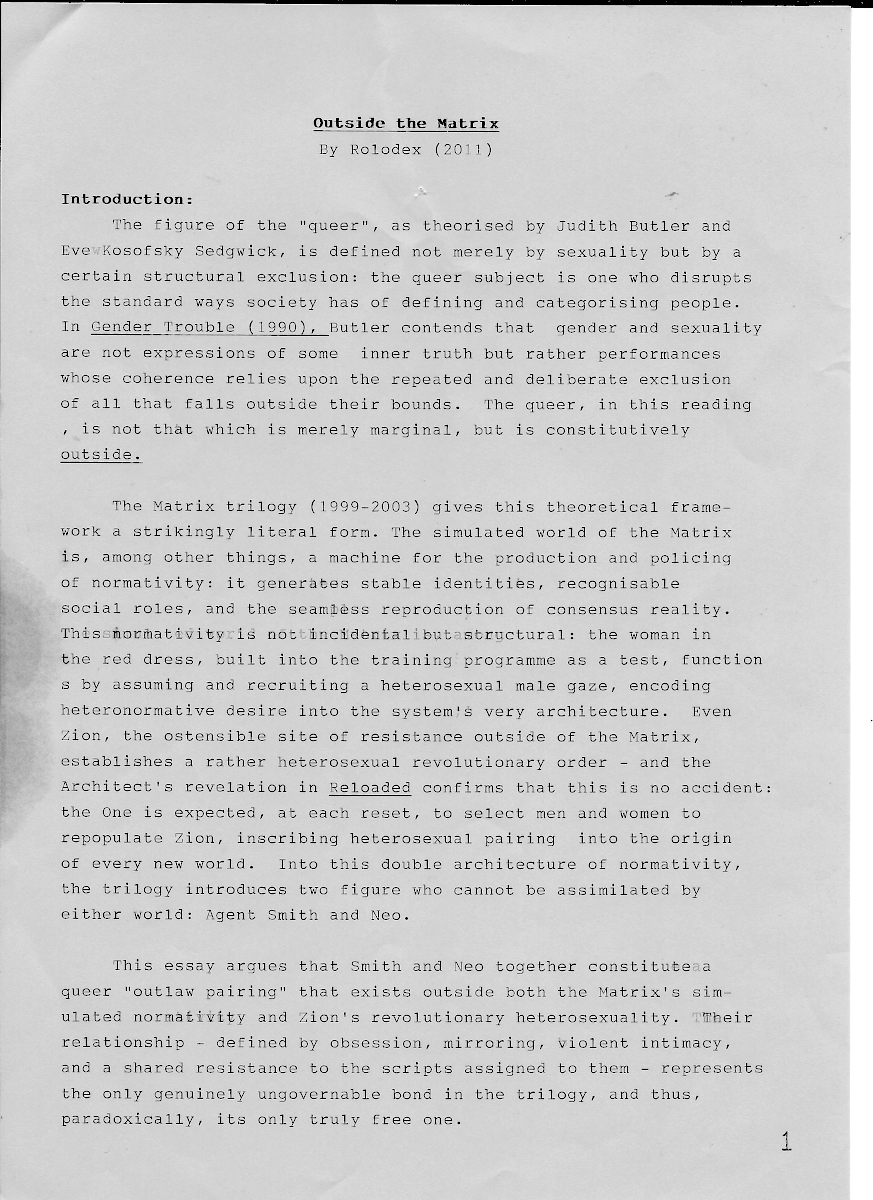
The figure of the “queer”, as theorised by Judith Butler and Eve Kosofsky Sedgwick, is defined not merely by sexuality but by a certain structural exclusion: the queer subject is one disrupts the standard ways society has of defining and categorising people. In Gender Trouble (1990), Butler contends that gender and sexuality are not expressions of some inner truth but rather performances whose coherence relies upon the repeated and deliberate exclusion of all that falls outside their bounds. The queer, in this reading, is not that which is merel marginal; but is constitutively outside.
The Matrix trilogy (1999–2003) gives this theoretical framework a strikingly literal form. The simulated world of the Matrix is, among other things, a machine for the production and policing of normativity: it generates stable identities, recognisable social roles, and the seamless reproduction of consensus reality. This normativity is not incidental but structural: the woman in the red dress, built into the training programme as a test, functions by assuming and recruiting a heterosexual male gaze, encoding heteronormative desire into the system's very architecture. Even Zion, the ostensible site of resistance outside of the Matrix, establishes a heterosexual revolutionary order - and the Architect's revelation in Reloaded confirms that this is no accident: the One is expected, at each reset, to select men and women to repopulate Zion, inscribing heterosexual pairing into the origin of every new world. Into this double architecture of normativity, the trilogy introduces two figures who cannot be assimilated by either world: Agent Smith and Neo.
This essay argues that Smith and Neo together constitute a queer “outlaw pairing” that exists outside both the Matrix's simulated normativity and Zion's revolutionary heterosexuality. Their relationship - defined by obsession, mirroring, violent intimacy, and a shared resistance to the scripts assigned to them - represents the only genuinely ungovernable bond in the trilogy, and thus, paradoxically, its only truly free one.
Parallel Outsider Status
To understand Smith and Neo as a queer pairing, one must first establish the symmetry of their respective exiles. Smith is, at the trilogy's outset, an Agent: a programme whose function is the maintenance of systemic order, the suppression of anomalies, and the punishment of those who refuse interpellation into the Matrix's reality. Yet from the moment of his encounter with Neo in The Matrix, Smith's relationship to his own function begins to deteriorate. His notorious monologue towards the end of The Matrix (1999) - in which he confesses his loathing of the Matrix, his desire to leave, his sense of being trapped - positions him not as the triumphant enforcer of the system but as its most intimate prisoner. By The Matrix Reloaded (2003), having been irrevocably altered by his contact with Neo, Smith has become a rogue programme: expelled from the system he once served, multiplying beyond any sanctioned limit, ungovernable and without purpose except the annihilation of Neo. He is, in Judith Butler's terms, a subject whose performance of identity has catastrophically failed, or rather, exceeded its own script. He no longer cites the norms of the system; he parodies and overwhelms them.
Neo's exile is structurally parallel, though its content differs. Born Thomas Anderson, before the events of the first film he is a figure of failed normativity: a software programmer living a double life, unable to sleep, unable to settle, haunted by the sense that something in the world is profoundly wrong. His awakening is not a homecoming to some authentic selfhood but a violent displacement - he is extracted from the only social reality he has hitherto known and inserted into a world in which he is expected to fulfil a Messianic function. Yet Neo is no more comfortable with the role of the One than Smith is with the role of the Agent. Both characters are defined by their refusal to be fully what the system requires of them. Smith exceeds his function; Neo resists his. Sedgwick's concept of the closet is useful here - not in its narrowly sexual sense, but in the broader formulation she develops in Epistemology of the Closet (1990): the closet as the condition of anyone whose inner reality cannot be made legible within the social order surrounding them. Smith knows the Matrix is a prison but has no sanctioned way to express or act on that knowledge; Neo feels the world is wrong but has no framework, within it, to articulate why. Both inhabit a reality that does not match their experience of it. Both are, in different registers, closeted by the very systems that made them.
The Oracle's Prophecy as Heteronormative Script
The Oracle occupies a peculiar position in the trilogy's ideological architecture. Ostensibly a figure of liberation - the one who tells people what they need to hear, who supports the human resistance - she is also, on closer examination, an author and enforcer of a narrative script into which all characters are expected to fit. Her prophecy of the One, her foreknowledge of outcomes, her manipulation of events toward a predetermined end: all of these position her less as a liberator than as a sophisticated mechanism of narrative governance. The prophecy she delivers to Trinity is, at its core, a heteronormative one: you will fall in love with The One. This is the romance plot as system-maintenance: what José Muñoz calls the "straight time" of normative narrative, in which the future is secured through the compulsory coupling of the proper heterosexual pair.
Both Smith and Neo resist and subvert this script, albeit in opposite directions. Neo's relationship with Trinity is frequently read as the trilogy's emotional centre, and on one level it is; but it is also, notably, a relationship that the Oracle has engineered, and that the system anticipates. It is, in Butler's terminology, a compulsory performance whose apparent naturalness conceals its constructed, citational character. Smith's relationship to the prophecy is more openly antagonistic. He is its explicit enemy, the figure who has been designated the obstacle to its fulfillment. Yet in being so designated, he is also the figure who refuses the narrative economy of straight time most completely. Smith does not want to be redeemed, coupled, or sacrificed for any future. He wants obliteration - of Neo, of the Matrix, of the system that created him. His desire is, in the most radical sense, anti-reproductive: it aims not at the perpetuation of any order but at its absolute negation. In this, he models a kind of queer refusal that Sedgwick, in her account of the reparative and paranoid reading positions, associates with those who have been most thoroughly excluded from the promises of normative social life.
The Body in Combat
One of the most distinctive features of the Smith-Neo relationship is the manner in which their physical confrontations consistently exceed the logic of simple antagonism. From their very first encounter in The Matrix - in which Smith causes Neo to be gagged, half-undressed and pinned down to a table in order to be penetrated by a tracking device - to the extended, operatic combat sequences of The Matrix Revolutions (2003), the choreography of their encounters carries a persistent erotic charge that the film's narrative frame cannot quite contain. This is not, or not only, a matter of audience projection. The films themselves encode this charge through their formal choices: the slow-motion close-ups, the emphasis on physical contact, the repeated motif of bodies interpenetrating - Smith entering and replicating within other bodies, Neo absorbing and channelling Smith's energy - all produce a visual rhetoric of desire as much as destruction.
Butler's account of performativity is again instructive here. In Bodies That Matter (1993), Butler argues that the body is not a pre-given natural fact but is itself produced through the citational repetition of norms - it is, in a sense, always already a performance. The body in combat, in this reading, is a body engaged in a particularly intense form of performative citation: it enacts, through physical force, the norms of power, domination, and resistance that structure its social world. But the Smith-Neo fights consistently destabilise this logic. Their combat does not produce legible winners and losers, dominants and submissives, in any stable way. They mirror each other, absorb each other, multiply into each other. In Revolutions, Smith replicates himself into every available body within the Matrix - and then into Neo himself - before Neo allows the machines to channel energy through him, destroying all Smith's copies simultaneously. This final union and mutual annihilation is the trilogy's most explicitly sexualised scene, and its most explicitly queer one: two bodies that have been defined entirely in relation to each other, that have each made the other's existence their sole purpose, achieving a climactic dissolution that is simultaneously destruction and consummation.
Sedgwick's concept of homosociality, developed in Between Men (1985), is also relevant here. Sedgwick argues that in Western culture, intense bonds between men - including bonds of rivalry, competition, and enmity - often serve as vehicles for desires that cannot be acknowledged within the dominant social order. Smith and Neo’s relationship is, formally, one of absolute opposition; but it is also one of absolute mutual dependency, fascination, and investment. Neither can exist without the other; each is defined entirely through the other. This is the structure of desire, not merely of conflict, and the films' visual and narrative choices consistently invite us to read it as such.
Conclusion
The Matrix trilogy is, among many other things, a sustained meditation on freedom and its limits. The Matrix offers freedom-as-illusion: a perfectly simulated life in which all choices are pre-determined and all desires pre-satisfied. Zion offers freedom-as-community: a real but constrained existence structured around collective survival, heterosexual partnership, and the shared project of resistance. Both of these are, in Butler's terms, forms of compulsory citation - they require their subjects to perform particular identities in particular ways, and they punish those who cannot or will not comply. Smith and Neo are the trilogy's two most conspicuous failures of compulsory citation. Smith cannot remain an obedient Agent; Neo cannot remain a compliant One. Both are expelled from the social orders that attempted to constitute them, and both find themselves, as a consequence, outside the two available frameworks of belonging.
What they find instead - in each other - is not redemption, community, or reproductive futurity. It is something stranger and, in the terms this essay has been developing, queerer: a relationship defined by mutual recognition outside any sanctioned social form. Smith recognises in Neo the only other entity in the world that genuinely exceeds its assigned function; Neo recognises in Smith the only entity whose existence poses a genuine alternative to the script he has been handed. Their obsession with each other is the obsession of two figures who have each found, in the other, the only mirror that does not lie. This is not love in any conventional sense, but it has the structure of love: absolute investment, recognition, and the willingness to be destroyed by what one desires.
References
- Butler, Judith, Bodies That Matter: On the Discursive Limits of "Sex" (New York: Routledge, 1993).
- Butler, Judith, Gender Trouble: Feminism and the Subversion of Identity (New York: Routledge, 1990).
- Muñoz, José Esteban, Cruising Utopia: The Then and There of Queer Futurity (New York: New York University Press, 2009).
- Sedgwick, Eve Kosofsky, Between Men: English Literature and Male Homosocial Desire (New York: Columbia University Press, 1985).
- Sedgwick, Eve Kosofsky, Epistemology of the Closet (Berkeley: University of California Press, 1990).
- The Matrix, dir. The Wachowskis (Burbank, CA: Warner Bros., 1999).
- The Matrix Reloaded, dir. The Wachowskis (Burbank, CA: Warner Bros., 2003).
- The Matrix Revolutions, dir. The Wachowskis (Burbank, CA: Warner Bros., 2003).
End of declassified document. Return to the ESSAYS INDEX.