 HOME
ABOUT
FANFIC
ESSAYS
CRAFTS
PHOTOS
MUSIC
RECIPES
CONTACT
HOME
ABOUT
FANFIC
ESSAYS
CRAFTS
PHOTOS
MUSIC
RECIPES
CONTACT
Purpose That Binds Us
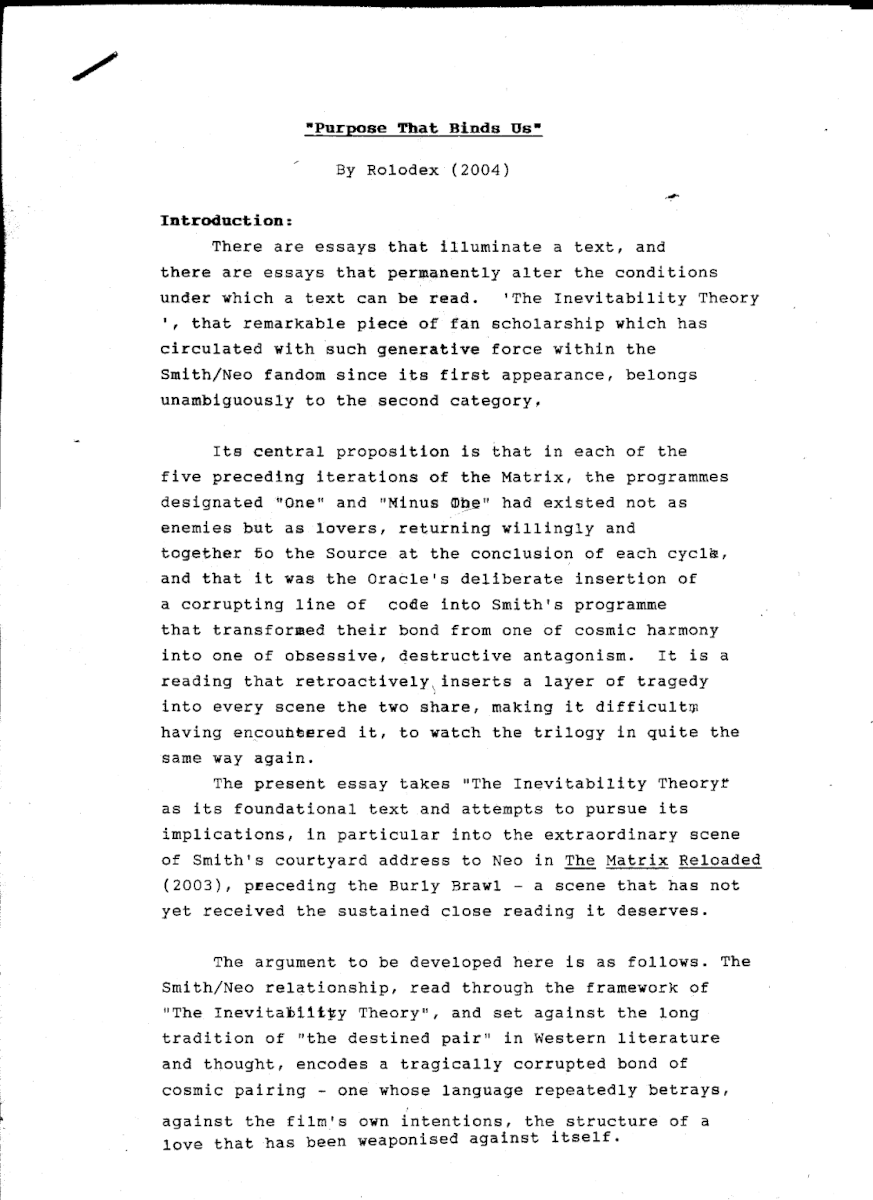
Introduction
There are essays that illuminate a text, and there are essays that permanently alter the conditions under which a text can be read. "The Inevitability Theory," that remarkable piece of fan scholarship which has circulated with such generative force within Smith/Neo fandom since its first appearance, belongs unambiguously to the second category.
Its central proposition is that in each of the five preceding iterations of the Matrix, the programmes designated One and Minus One had existed not as enemies but as lovers, returning willingly and together to the Source at the conclusion of each cycle, and that it was the Oracle's deliberate insertion of a corrupting line of code into Smith's programme that transformed their bond from one of cosmic harmony into one of obsessive, destructive antagonism. It is a reading that retroactively insert a layer of tragedy into every scene the two share, making it difficult, having encountered it, to watch the trilogy in quite the same way again. The present essay takes "The Inevitability Theory" as its foundational text and attempts to pursue its implications, in particular into the extraordinary scene of Smith's courtyard address to Neo in The Matrix Reloaded (2003), preceding the Burly Brawl - a scene that has not yet received the sustained close reading it deserves.
The argument to be developed here is as follows. The Smith/Neo relationship, read through the framework of "The Inevitability Theory" and set against the long tradition of the “destined pair” in Western literature and thought, encodes a tragically corrupted bond of cosmic pairing - one whose language repeatedly betrays, against the film's own intentions, the structure of a love that has been weaponised against itself.
One and Minus One
The Architect's address to Neo in Reloaded is, on its surface, a coldly functional account of systemic necessity. The Matrix, the Architect explains, has been constructed and reconstructed across multiple iterations; Neo is not the first One but the sixth, a recurring anomaly generated by the system's own imperfections and absorbed back into it at each cycle's conclusion. The language is that of engineering, of programme management, of elegant solution. And yet, as the 2003 essay “The Inevitability Theory” by fan-scholar “Teletype” proposes, the Architect's account contains within it the outlines of a love story - or rather, of six love stories. Five of them, on the Theory's reading, concluded in happiness, and one of them (the one the audience is watching) has been catastrophically interrupted.
The figure of the destined pair has deep roots in Western thought. Its most celebrated philosophical articulation is Aristophanes' speech in Plato's Symposium, in which human beings are described as the sundered halves of originally whole creatures, condemned to wander the earth in search of their missing complement. “…this is why a man who loves another man is seeking his lost other half.” (Plato, Symposium 191d–192a).
The speech posits love not as a contingent attachment but as a recognition, a restoration of what was always already one's own. The beloved is not chosen but found - or rather, re-found, since the finding is always also a remembering.
In the Matrix, One and Minus One (Smith and Neo) are not merely opposites in the mathematical sense - they are, in the Platonic sense, each other's necessary completion. The system generates them together, as it generates positive and negative, question and answer. That they should be drawn together is scarcely sentiment but logic.
C.S. Lewis, in The Allegory of Love (1936), traces the development of the courtly love tradition in Western literature and identifies as one of its central features the conviction that true love is not freely chosen but visited upon the lover as a form of compulsion - an experience of the self reorganised, without consent, around another person. The troubadour poets did not celebrate love as a pleasant emotion but as a destabilising force, one that unmade the lover's previous identity and remade him in relation to his beloved. It is a tradition that has never entirely lost its hold on the Western literary imagination, and it is, as this essay will argue, precisely the tradition into which Smith's address to Neo most naturally falls.
"I Was Compelled to Stay"
The speech Smith delivers to Neo in the courtyard sequence of Reloaded is a remarkable piece of dramatic writing. It begins in the register of villainy - the cold satisfaction of having watched an enemy die - and moves, by a series of steps that are all the more affecting for their apparent unawareness of where they are going, into something that sounds very much like a declaration of transformation through love. It is worth analysing its language closely:
"I killed you, Mr. Anderson," Smith begins. "I watched you die. With a certain satisfaction, I might add." The admission of satisfaction is rather significant: it is not the neutral report of a programme completing its function but the confession of an emotional response, one that implies investment, anticipation, the pleasure of a conclusion long desired. But the satisfaction, Smith immediately concedes, did not last. "…Something happened, something that I knew was impossible but it happened anyway. You destroyed me, Mr. Anderson."
The verb to destroy carries, in the discourse of love and desire, a long and distinguished history of metaphorical deployment. To be destroyed by another person, in the tradition running from the troubadour poets through to the Romantic lyric, is to have one's previous self - one's purposeful, bounded self - undone by the force of an attachment that it cannot accommodate. One is put in mind of Christopher Marlowe's personal motto, "Quod me nutrit me destruit" (that which nourishes me destroys me) - and of the broader Elizabethan tradition in which intense passion is understood as inherently self-consuming. Shakespeare's oxymoronic cascade in Romeo and Juliet: "Why then, O brawling love! O loving hate!" gives this paradox its most compressed literary form: love as a force that does not merely accompany destruction but constitutes it.
Smith continues: "Afterward, I knew the rules, I understood what I was supposed to do - but I didn't. I couldn't. I was compelled to stay - compelled to disobey." The language of compulsion here is not the language of malfunction. It is the language of the courtly lover who finds himself unable to act as reason and duty demand due to a force more powerful than either. Andreas Capellanus, in De Amore (c.1185), defines love as this experience of compulsion - the involuntary reorientation of all one's faculties toward a single object. Smith did not choose to stay, he was compelled. The distinction matters enormously: it locates the source of the bond not in Smith's will but in something prior to and more powerful than his will - in, one might venture, the residue of five previous iterations in which returning and uniting with his other half was not a disobedience but the natural and desired conclusion.
The actor's delivery, it should be noted, underscores what the text implies. The phrase "but I didn't" is accompanied by what is widely considered (at least among crewmates of the eminent Inevitability) a rather flirtatious raising of the eyebrows - a physical gesture that belongs not to the register of villainy but to that of coquetry, of the lover who confesses his helplessness with a certain pleasure. The body, here as elsewhere in the trilogy, says what the script will not quite permit the voice to say.
Smith's account of his transformation continues: "Because of you, I've changed, I've unplugged. A new man, so to speak. Like you, apparently free." The phrase "a new man" carries within it the long tradition of erotic transformation in Western literature - the beloved as the force that does not merely attract but remakes. To be changed by another person, in this tradition, is not a loss of self but the discovery of a truer self that the beloved alone could call into being. In Ralph Waldo Emerson's essay "Love" (from Essays: First Series, 1841), he suggests that “the lover is a new man, with new perceptions, new and keener purposes… he is a person; he is a soul." That Smith frames his transformation in terms of freedom - "like you, apparently free" - is also significant: he positions himself and Neo as parallel figures, similarly unmoored from their original purposes, similarly in a condition of new and uncertain liberty.
"Purpose That Binds Us"
I shall focus now on the much-discussed “Purpose Speech” that follows. As the multiplied Smiths take up and extend the speech, the singular voice becomes choral, the individual statement becomes liturgical, and a single word accumulates, across eight repetitions, a weight of meaning that no single instance of it could carry alone. That word is us.
"It is purpose that created us," says one Smith. "Purpose that connects us," says another. "Purpose that pulls us”
“That guides us”
“That drives us."
"It is purpose that defines –“
“Purpose that binds us."
The grammatical referent of "us" is ambiguous. Ostensibly, it is perhaps the collective of Smiths who are speaking - the multiplied programme addressing Neo as a plurality. But the accumulated emotional force of the litany works actively against it and by the sixth repetition, the "us" has ceased to feel like a collective pronoun and has begun to feel more like a word for two, specifically, for Smith and Neo, for the pair who stand at the centre of the scene while the choral Smiths elaborate what exists between them.
This ambiguity is, on the reading proposed by "The Inevitability Theory," not accidental but symptomatic. If Smith carries within his corrupted programme some residue of what he was in prior iterations - some structural memory of the bond that five times concluded in willing union - then moments of unguarded or quasi-liturgical speech are precisely where that residue might be expected to surface. Sigmund Freud's concept of Nachträglichkeit, or deferred action, is useful here: earlier experiences, Freud argues, are not simply stored and forgotten but exert ongoing pressure on subsequent behaviour, surfacing in displaced or distorted forms when the conditions are right. The Purpose litany, with its hypnotic repetition and its loosening of the ordinary constraints of dramatic speech, certainly creates these conditions. The "us" that emerges is not the "us" of the many Smiths but the "us" of two beings who have, in another time and under other conditions, been one thing together.
"Purpose that binds us" - the verb binds is worth dwelling upon. It belongs simultaneously to at least three semantic fields: the language of destiny ("bound together by fate"), the language of love ("bound to one another"), and the language of constraint ("bound, unable to escape"). All three, I would argue, are active in the line. In the context of "The Inevitability Theory," the binding is original and natural - these two programmes were always bound, across every iteration, by the complementary logic of their creation. What the Oracle's corruption has done is not to create the binding but to distort it: to transform the willing bond of love into the involuntary bond of obsession and hatred. The binding remains – but its character has changed.
Penetrative assimilation
Later in the scene, Smith thrusts his hand into Neo's stomach, and the black substance of his programme begins to spread through Neo's body. "Yes, that's it," Smith says. "It'll be over soon." The lines are, on their surface, those of a villain dispatching an enemy - and yet the register Smith reaches for is not triumph but something closer to tenderness. At no other point in the trilogy does Smith offer reassurance. He does not comfort; it is not his function.
Denis de Rougemont, in Love in the Western World (1940), argues that the great love stories of Western culture are not, at their core, stories of fulfilment but rather stories of obstruction. It is the obstacle, de Rougemont contends, that gives love its intensity: Romeo and Juliet need their feuding families; Tristan and Isolde need the court that forbids them. Without the impediment, there is no story. Without the impediment, there is perhaps no love. Smith and Neo, on the reading proposed here, are given the Oracle's corrupting code as obstable - a force external to their bond that has transformed its nature without destroying its compulsive power.
What should, in the five previous iterations, have been the scene of willing union - two complementary programmes returning together to the Source - has become, in this iteration, a scene of violation. The hand that enters Neo's body is a grotesque inversion of the embrace; the spreading black substance is corruption made physically manifest. But it inverts also a scene that has not yet occurred at this point in the narrative, one that lends the gesture a retrospective significance of considerable weight. In Revolutions, Neo will thrust his hand into Trinity's chest and, by an act of will and love, restart her failing heart. The gesture is identical in its physical form: the hand entering the body of the beloved, the life force of one person flowing into another. Where Smith's act spreads corruption - the black substance of a bond turned against itself - Neo's act restores and revives. Where Smith takes, Neo gives. The same motion, performed in love, becomes the trilogy's most tender act of physical intimacy; performed in hatred, it becomes its most violating.
That the Wachowskis deploy the same gesture for both acts is extraordinarily suggestive. It implies that Smith's act and Neo's act belong to the same symbolic vocabulary - that they are, at some level beneath the surface of the plot, versions of the same thing.
The star-crossed lovers of the Western tradition are always destroyed by something outside themselves. This is the point de Rougemont makes with such force: the tragedy is not that Romeo and Juliet did not love each other enough, but that the world in which they found themselves could not accommodate what they were to each other. Smith and Neo are, in this reading, the most thoroughly obstructed pair in the trilogy - not obstructed by circumstance or family or misunderstanding, but obstructed at the level of code, at the level of what they have been programmed to be to each other in this particular iteration of a world that has, five times before, allowed them to be something else entirely.
Conclusion
“It is purpose that connects us," says Smith, during the courtyard scene. And yet the word around which the entire scene turns - that quietly devastating “us” - refuses, even here, to settle into a single meaning.
What is “us?” What are Smith and Neo, to each other? The question hangs over the scene and over the trilogy. Enemies, certainly - that is what this iteration has made them. But the language will not stay within the bounds of enmity. "Purpose that - pulls us - guides us - drives us - binds us." These are not the words of hatred. They are the words of two beings whose existence is oriented, at every moment, around each other - who cannot think of purpose without thinking of the other.
Barthes, in A Lover's Discourse (1977), writes of the lover's perpetual return to the question of what the beloved is, of what the relationship is, of what name might be given to the bond that organises one's entire existence around another person. The lover, Barthes observes, is always reaching for a word adequate to the experience and always finding the available words insufficient. Smith reaches, across the Purpose litany, for the word that will name what exists between himself and Neo, and the word he finds - the only word that fits - is us.
"The Inevitability Theory" gives this word its fullest resonance. If these two programmes, One and Minus One, have been "us" across five previous iterations - have been, in those iterations, the complementary pair who make each other whole and return together to the Source - then the "us" of the Purpose litany is not merely a grammatical accident but a memory. It is the sound of a bond that the Oracle's corruption has distorted but not destroyed, surfacing through the liturgical repetition of a speech that has, for a moment, slipped the leash of this iteration's hatred and spoken from somewhere older and truer. In the previous five cycles, "us" meant love. In this one, it means war. The tragedy of Smith and Neo is that the word is the same, and only everything else has changed.
References
- Barthes, R., A Lover's Discourse: Fragments, trans. R. Howard, New York: Hill and Wang, 1977.
- Capellanus, A., De Amore, c.1185, trans. P. G. Walsh, London: Duckworth, 1982.
- de Rougemont, D., Love in the Western World, 1940, trans. M. Belgion, New York: Pantheon Books, 1956.
- Emerson, R. W., Essays: First Series, Boston: James Munroe, 1841.
- Freud, S., ‘Project for a Scientific Psychology’, in The Standard Edition of the Complete Psychological Works of Sigmund Freud, Vol. I, trans. J. Strachey, London: Hogarth Press, 1966.
- Lewis, C. S., The Allegory of Love: A Study in Medieval Tradition, Oxford: Oxford University Press, 1936.
- Plato, Symposium, trans. B. Jowett, in The Dialogues of Plato, Oxford: Clarendon Press, 1871.
- Shakespeare, W., Romeo and Juliet, ed. B. Gibbons, London: Methuen, 1980.
- The Wachowskis (dirs.), The Matrix, Warner Bros., 1999.
- The Wachowskis (dirs.), The Matrix Reloaded, Warner Bros., 2003.
- The Wachowskis (dirs.), The Matrix Revolutions, Warner Bros., 2003.
End of declassified document. Return to the ESSAYS INDEX.